I’m No Henry Ford

Standard

IMG_0585


In 1908 Henry Ford introduced the Model T, a relatively affordable automobile built for “the masses.”  Not satisfied with the time and expense involved with building each one separately, he came up with the innovative idea of a moving assembly line.  Five years later, in 1913, Henry put his idea into practice.  As the vehicles moved down the line, at a rate of six feet per minute, workers installed specific parts repetitively.  Production time was cut by nearly 80%, costs were reduced significantly, and quality was improved.  American manufacturing was changed forever.

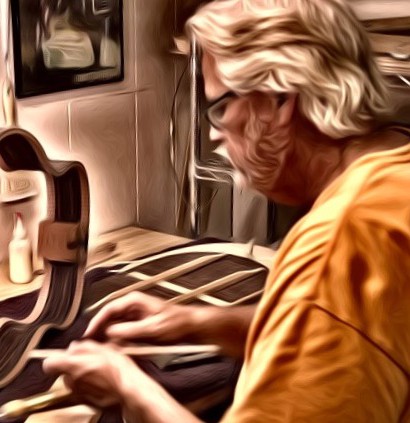
I toured the Martin Guitar Factory in Nazareth, PA, and saw this process firsthand.  As guitars move down the line parts are cut, routed, sanded, finished, etc. by sophisticated CNC equipment (computer controlled machinery that replicates each step precisely and exactly).  The human element is still evident, however, as experienced craftsmen oversee and execute many of the steps by hand, producing superb instruments.  Very impressive!

So I thought (always risky as my mind is like a bad neighborhood – dangerous to go in there alone) why not employ old Henry’s assembly line in my own little shop?  After all, as long as I have one tool out and set up wouldn’t it be just as easy to do multiples instead of just one?  I could effectively reduce the time involved for each guitar, save the hassle of having to get out and put away the necessary tools so many times and, as long as I’m making a mess, gather up large quantities of sawdust instead of just a little.  A most excellent concept BUT, as I’m finding out, not well-suited for my situation.  I’m learning that this only works well if the guitars I’m building are all meant to be the same.  They’re not.

I’m currently working on four cigar box guitars and all are very different.  The wood, measurements, string scale, components, box, and intended purpose are unique to each.  So the creative design and engineering that goes into the thought process fluctuates vastly from guitar to guitar.  And while it is, indeed, easier to have just one tool out at a time it is not conducive to speed.  I have to be very careful to make sure that I do not confuse measurements and specs as I move from piece to piece.  Upon completion each guitar will be great, I will be proud, and their new owners will be happy.  I will not, however, be building this way again in the near future.  For me it’s not about efficient production, it’s all about the creativity.

I love designing guitars in my head.  I love selecting the wood, choosing components, carefully measuring, cutting, gluing, assembling, and applying finish.  I love sitting back to admire and learn from the step I’ve just completed.  Every guitar I build develops a personality, “soul” if you will, along the way.  It comes alive and actively helps modify and choose what it will eventually become – an instrument producing beautiful, mystical music through the hands of a skilled player.  The guitars I build deserve individual attention.

I’m no Henry Ford.


Choice: the fuel of Creativity

Standard

IMG_0576

I’ve learned, and am continuing to learn, that many things are required in the building of guitars; skills, tools, advice, patience, etc.  The one component, however, that I find to be the most intriguing, challenging, and time consuming is choice.  Every single step in the process (wood, components, glue, inlay, bracing, finish, etc.) involves the consideration of hundreds, even thousands of possibilities, each which much be given proper thought.  Once chosen, that course of approach necessarily excludes all others and then leads to the next round of engineering, design choices.  This takes time.  And for me – a lot of time!

Right now I have four cigar box guitars on my bench. a return to my roots in guitar building, if you will.  One, a commission, is a three string slide guitar, another is a four string “lefty,” the third is a three string resonator (for which I am using an inverted dog dish), and the fourth is a six string electric.  I have spent hours contemplating the possibilities of each one.

I have a chair in my workshop.  Occasionally my wife, Ramona, will come out and find me seated there.  “I thought you were building guitars,” she’ll say.  My response is always the same:  “I am!”

Choices, possibilities, decisions – all provide the creative flow of life.

Why Short Pants?

Standard

My grandfather, Clarence Littleton, was a man of diminutive physical stature, often buying his clothes in the boys department at J.C. Penney.  He quit school following the fifth grade to help support his struggling family.  Marrying young, he and my grandmother had one child, my mother, and Grandpap took a job at Imperial Glass in Bellaire, Ohio, as a glassblower.  Difficult times dictated a move to Akron where he worked at Akron Standard Mold, producing molds for the tire industry.  They purchased a small home at 91 Dellenberger Avenue, onto which he built an addition.  Not being able to afford vacations, he fabricated and built a small travel trailer.  He was a creative, self taught man of many talents.  He loved electronics, built his own radios, and was an avid cb radio guy,  I still remember his call letters:  KLN7621.  He played keyboards, trumpet in the Salvation Army Band, and . . the guitar.

I have three brothers.  All of us play the guitar.  We learned our first chords under his tutelage on his old Harmony Stella guitar.  That guitar disappeared somewhere over the years since 1978, when he died at the age of 67.  I wish I had it.  But I don’t.

Unlike my grandfather, I am a “big burly man,” as the German newspaperman put it after interviewing me for an article a few years ago.  I have undergraduate and graduate degrees.  I’ve had opportunities he never could have imagined and, although not wealthy by any means, I’ve led a comfortable life.  But this is what we have in common.  This is the connection – the love of building things.

Over the last couple of years I’ve built fourteen guitars; cigar box, acoustic, electric, and lap steel.  I’ve sold a few, given a few away, and kept a couple for myself.  There’s not a time when I’m in my shop that I don’t at least think once of my grandfather, imagining what we could have built together.  I miss him!

The name his buddies and coworkers called him?  Short Pants